
Archives for "Education"
Finding Volumes of Cubic Unit Cells
In chemistry, the unit cell of a crystalline solid is the basic building block of that crystal. A crystal lattice is formed by stacking these unit cells three-dimensionally. Perhaps the most basic unit cell is the cubic unit cell—so named because it is, in fact, shaped like a cube. The cubic unit cell comes in three flavors: simple, body-centered, and face-centered.
Finding the volume of a cubic unit cell is easy if you are given  , the edge length:
  . It is also relatively easy if given the density and mass of the element:
  .
.
What if, however, you are only given the element’s atomic radius? We will use geometry to derive a formula for the volume of a cubic unit cell in each of the three varieties.
Simple Cubic Unit Cells
A simple (sometimes called primitive) cubic unit cell has atoms at each of the eight corners. The locations of the atoms are called lattice points.
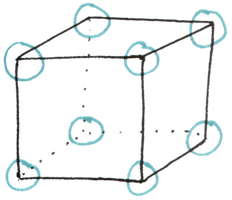
Let’s focus on just one of the faces of a polonium unit cell:
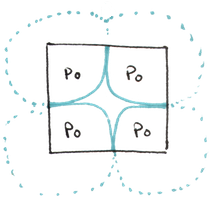
You should note that only part of each atom is drawn in a solid line—this is to indicate that only part of each atom is contained in a given unit cell. For corner lattice points, this portion is 1/8th.
From the picture, we can see that the length of each edge is determined by the radii of two Polonium atoms. Thus  and
and -3-bg-ffffff-fg-000000-s-0.jpg "V = (2r)^3") .
.
For polonium, whose atomic radius is 168 pm,  .
.
Body-centered Cubic Unit Cells
A body-centered cubic unit cell has a lattice point in the middle of the cell, as well as at each corner:
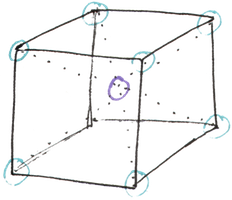
Of note in the above picture is that the atom identified in purple is situated directly in the middle of the cell, at the intersection of the cube’s body diagonals.

The technique used to solve the problem in the case of a simple cubic unit cell won’t work here, because the edge length is not an easily recognizable multiple of the radius of each atom. That is, if we look at one of the cell’s faces, we see there is a gap of unknown size between the two corner atoms (molybdenum in this case).
What we would like to do is determine the length of the edge; we do this by relating the body diagonal, the face diagonal, and the edge length via the Pythagorean theorem.
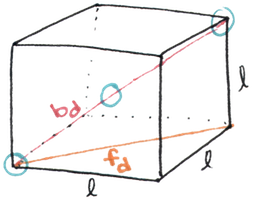
Let  be the length of the body diagonal. Since there are two corner atoms each with width
  and one atom in the center with width
  , we can see that
  .
.
Let  be the length of the face diagonal. By the Pythagorean theorem,
  .
.
Applying the Pythagorean theorem to the triangle formed by the body diagonal, the face diagonal, and one of the edges gives  . Hence
  and
and -3-bg-ffffff-fg-000000-s-0.jpg "V = (\frac{4r}{\sqrt{3}})^3") .
.
For molybdenum, whose atomic radius is 139 pm,  .
.
Face-centered Cubic Unit Cells
A face-centered cubic cell has lattice points in the center of each face as well as at each corner. It does not have a lattice point in the center of the cell:
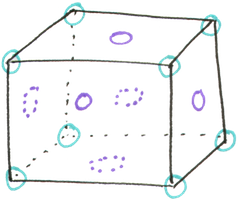
In the picture, the blue circles are corner lattice points, while the purple circles are face lattice points. The dashed purple circles are those lattice points obscured by other faces.
Looking at one of the faces, we can see that, unlike in a body-centered unit cell, the three nickel atoms touch along the face diagonal:
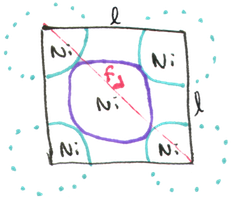
Thus the calculation in this case is actually fairly straightforward: -2 - 2l-2-bg-ffffff-fg-000000-s-0.jpg "f_d^2 = (4r)^2 = 2l^2") . Hence,
. Hence,  and
and -3-bg-ffffff-fg-000000-s-0.jpg "V = (\sqrt{8}r)^3") .
.
For nickel, whose atomic radius is 124 pm,  .
.
 Made by Symmetric Web
 Distributed by Smashing Magazine